How creative copywriting drives strategy at Halo
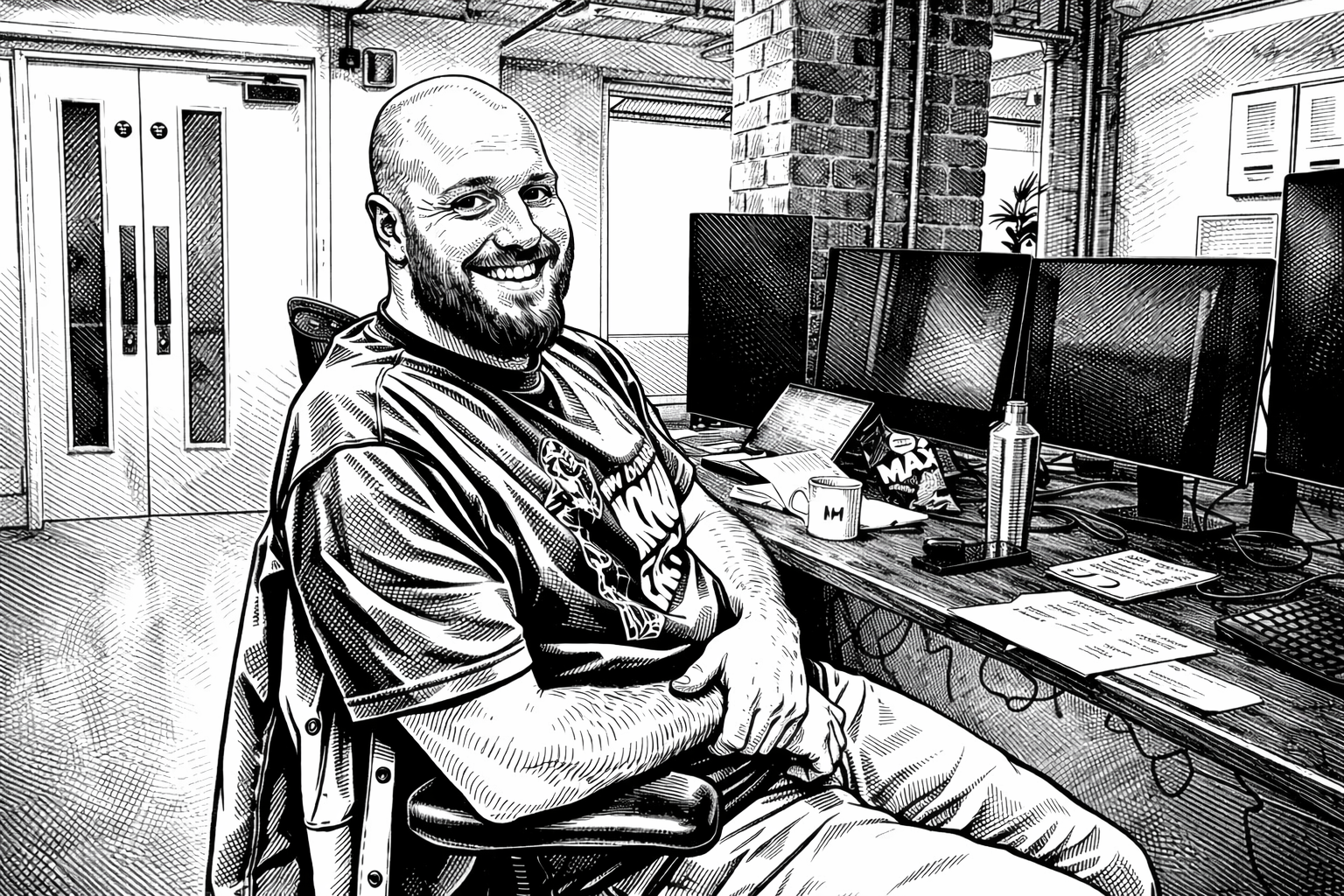
As part of a new series for Halo Fuel, where we go behind the scenes at Halo, we sat down with our Conceptual Copywriter, Sam Ledbury, to talk about the importance of keeping it real in the age of AI.
We’re living in a generative-AI era, saturated with polished thought pieces, worryingly real deep fakes and a landslide of digital slop. Whether a family member is sending a cat playing a ukulele (and thinking it’s real) or an old school friend is engaging with political propaganda, we’re struggling to know what’s real or not. As AI creeps into every corner of our lives, it’s important for brands to find the balance between using it as a tool for efficiency and keeping a human touch for craft.
As predicted by trend forecasters, we are already seeing a shift in consumer behaviour. The desire for human interaction, nostalgic design, and in-person brand experiences is growing as a pushback against the digital, saturated, and noisy world. We’re starting to see brands play an important role in people’s lives, providing joy, comfort, and clarity, and this is a responsibility we shouldn’t take lightly.
People can recognise when brands use AI and when it’s authentic, and research has shown they don’t mind when it’s used as long as it's honest. We all know trust is a fragile concept, and it’s even more so as the need for authenticity grows. As we move to fully integrate AI, we need to be mindful of when, where and how we use it. Even OpenAI used real people in their Super Bowl ad, about AI.
One specialism that’s taken a hit due to the rise in generative AI is creative copywriting. But at Halo, we integrate this into the creative strategy process early on. We believe it’s important to bring soul and authenticity to ideas, and craft with a human gut feeling that AI can’t replace. That said, we’re not anti-AI. We even used it to assist with this interview, it’s written by humans, transcribed by AI. It has undoubtedly made things faster and more efficient, but speed can be the enemy of quality in the creative process. Great work needs time to craft, space to grow and room to breathe.
Can you share a bit about your journey into Creative Copywriting?
Sam Ledbury: So, the way I got into the industry is a bit of a long story, but the short version is that I ended up in a dead-end job working in a factory. I appreciated having the work, but I was really struggling to get out, and there was no future in it.
At the time, my now wife was at uni. I would go to work at 5:00 am, come back, and all that would happen is she would have made it from the top of the bed to the end of the bed to play Call of Duty: Black Ops 2 on my PlayStation. I was like, what is this? This is mental.
Halo: You must have been thinking where do I sign up?
SL: Exactly. But despite the gaming sessions, she was getting a great education and making contacts, and I was treading water, working yet another dead-end job. It was then I decided I needed to change something. But where to go? I had no idea.
While I was at college doing media, we had to do an advertising section, and I just loved it. So I Googled advertising in Cheltenham and the uni course popped up, I applied, and got in by the skin of my teeth.
I treated it like a job. I was the only person in my year born in the 80s, so I was a few years older than the 18-year-olds who were out for freshers' week. From the first brief, I was hooked, and I just started chucking myself in at every opportunity.
What attracted you to creative copywriting?
SL: I did not have a clue. I grew up in a place where everyone became an electrician or a plumber. When I left school, I actually became an electrical apprentice. It was never on my radar until I did that TV ad project at college. Even then, I thought it was just something cool you did at college and that it would never come to anything.
But I remember being a kid and seeing ads that stuck with me, like the Tango Slap ad or a VW ‘bollocks’ ad. It was smart and hilarious. I was fascinated by the world of ads, but it was just never on my radar until I stumbled across the university course.
Can you talk us through your creative process?
SL: It is weird because it is not necessarily a formula. Everyone can be creative, but the problem people sometimes struggle with is coming up with decent ideas every time: every week, every day, every brief.
I am old school. I am not on the internet or using a Mac for visuals. I am literally just getting an A4 marker pad and a permanent marker. I draw a box, and then I fill it. I want to find that nugget or that hook.
Halo: I always find that clients know the answer from a business perspective, but it is our job to figure out the creative expression that resonates with the audience.
SL: Exactly. We have to decrypt what they are going through. I am constantly writing and taking notes in meetings, even when people aren't necessarily saying anything specific. It is about being in the moment and letting those first ideas flow. Then I get out and have a walk. I do a lot of thinking on my commute in; I do not listen to music or podcasts; I just stay present and let things work through my mind slowly.
What’s a campaign you're most proud of?
SL: It has to be the first big campaign I did at Halo. I had been here for 6 months, and we were in a briefing on bagged salad. When you leave uni, you think you will be working on Nike, and then it is Fresh and Naked salad.
The whole point of the brand is that they do not wash the salad, so it stays fresher and is naked from the field. I was going through my notes and wrote down “naked farmer,” then just left it to the side, but it kept coming back up.
Halo: And it is in its second year now?
SL: Yes. It’s been great for our client. They love him; we have taken him beyond TV and print and have a lot planned for the second year that make the most of the character and the brand.
How do you feel about the use of generative-AI as part of the creative and agency process?
SL: AI is great, but it generalises things. When ChatGPT came out, people said to me, “oh, you are screwed”, but that was only one part of my job. I am a creative first and a copywriter second. AI is here to stay, but it is not as game-changing as people think.
Halo: There is that human element, isn't there? Understanding needs and having a human response.
SL: Exactly. You cannot recreate what humans can do or how fast we can evolve. I use it as a visualisation tool to prototype ideas or create storyboards that are better than my scamps, but it is not replacing anyone.
There is also the dead internet theory. It is the idea that everyone will get so fed up with the noise, the deep fakes, and the bots that they will turn off and go back to legacy media and a real human connection. That is why Reddit is huge: it is human. AI struggles because it lacks the nuance to make jokes or generate new insights. It has a billion touch points, but no perspective.
What do you think are the biggest challenges – or opportunities – facing the industry?
SL: They are two sides of the same coin. Technology moves so fast, and the goalposts are always shifting. For a while, it was influencers, but now people don’t trust them because everyone is sponsored.
The challenge is clients wanting to use AI just for the sake of it. The opportunity, however, is using AI to claw back time. If we can use it to speed up the doing, we can spend more time on the thinking. The thinking is what actually moves the needle for clients.
What are you most excited about next at Halo?
SL: We have some really great clients who are synonymous with the UK. I have been here 15 months, and it has been wicked. We have some exciting projects on the horizon with rebellious brands that want to push boundaries in unexpected ways. We have also got Halo Labs working in the background, so there is so much to come from this team.
Cutting through the Noise
Our industry faces the challenge of cutting through the noise while remaining true to ourselves. But with every challenge comes an opportunity. In an age of digital slop and over-processed content, brands have the chance to win by simply being honest, real and human. While AI can help speed up processes and increase efficiency, it simply can’t replace human craft, raw emotion, and genuine humour. Despite the changing industry, we are excited and optimistic for more brands that are willing to be rebellious, push creative boundaries and challenge convention.


